
How to build a wind turbine: from wind to blades and generator
| tutorial: build a wind turbine propeller | Example of making an axial flux generator with permanent magnets |
To build a wind turbine, we start from the available wind, choose the rotor and the generator, then match their rotational speeds. Heliciel helps with the trickiest part, the blade design: profiles, number of blades, twist and manufacturing plan.
This article introduces the tutorial "build a wind turbine propeller", which gives an example of a method to design the wind turbine blade with Heliciel.
In this page:
- Before building a wind turbine: type, wind and power
- Wind turbine components and the place of the rotor
- Choosing the generator of a wind turbine
- Matching the rotor speed to the generator speed
- Calculating and making the wind turbine blades
1: Before building a wind turbine: type, wind and power
Before making a wind turbine, we have chosen the type of wind turbine we want to build. We have also looked at the wind energy we can hope to capture. We therefore know the length of the blades to build, the nominal wind speed and an estimate of the power the generator will receive.
2: Wind turbine components and the place of the rotor
Building a wind turbine amounts to creating an energy generator. The components of a wind turbine are many: some are bought, others are built. Among those we build, we concentrate here on the key element, the wind turbine blades.

A three-blade wind turbine studied in Heliciel: the 3D view shows the rotor, and the gauges at the bottom of the screen give the power and torque at the shaft.
Heliciel concentrates on making the wind turbine propeller.
3: Choosing the generator of a wind turbine
We make the choice of generator knowing the power we plan to capture. The characteristics of generators differ with the solution adopted (dynamo, alternator, asynchronous generator). Whatever the solution, the generator gives us a power that depends on its rotational speed.
Whether the turbine is connected to a pump or to a generator, we need to know the shaft torque curve (of the generator or of the pump) as a function of rotational speed. We also need the speed at which the pump or generator reaches its best efficiency.
4: Matching the rotor speed to the generator speed
We try to make this best-efficiency speed of the generator or pump coincide with the optimum rotational speed of our wind turbine. Building an efficient wind turbine therefore requires choosing a reference wind speed, then adapting the rotor by choosing its geometry and its number of blades. The aim is to match as closely as possible the optimum rotational speed of the rotor to that of the generator.
To choose the site and the reference wind speed, the Heliciel software includes a series of interactive wind maps around the world.
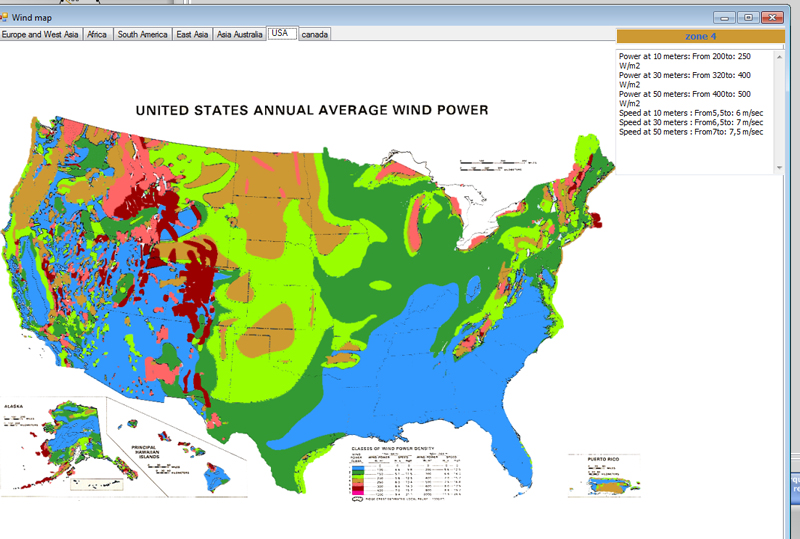
Interactive wind map of Heliciel, here the annual average wind power of the United States, with one tab per region. The panel at top right gives, for the selected zone, the wind power in W/m2 and the wind speed at 10, 30 and 50 metres.
5: Calculating and making the wind turbine blades
Heliciel lets us test airfoil geometries and numbers of blades until we get the wind turbine rotor with the best efficiency at the optimum rotational speed. Heliciel calculates the optimum blade twist and the optimum rotational speed for the selected profiles. For more information, see the design phases of a wind turbine and propeller.
- Heliciel supplies the plan of the wind turbine blades of the turbine you have modelled.
- You then choose a method to make the blades. The material and structure of the frame determine the strength of the blade. The two most widely used materials for building a wind turbine are wood and fibreglass.
The page on propeller and wind turbine blades gives examples of methods used to make wind turbine blades.
To go further, we can follow the tutorial on designing a wind turbine propeller, which continues this article with a complete example, or see how the power of a wind turbine varies with wind speed.
 Global site map
 Mecaflux
 Tutorials Mecaflux Pro3D
 Tutorials Heliciel
 Tutorials Heliciel PRO CFD
 Mecaflux Store
 Compare software functions
 Quotes, Orders, Payment Methods
 project technical studies